A Traditional Fijian Kava Welcoming Ceremony

Nadi, Fiji • February 2017 • Length of Read: 10 Minutes

After three days of being holed up in my hostel on the Fijian mainland due to a tropical storm, the bad weather finally subsided. The expat who I’d met at the bar on my first evening in the country, Andy Fritzl, may have given off vibes creepier than Hannibal Lecter, but I couldn’t comment negatively on the accuracy of his weather forecasting. He had been spot on in saying that we were going to be experiencing the worst storm in ten years that would not then turn into a cyclone. The flash flooding had been so bad that I would have needed a kayak just to get down the street to the local supermarket.

The cracks of blue sky that eventually appeared were much to the pleasure of Coral, the petite Israeli girl who had checked-in the day after myself. Upon arrival, she’d slept for near-enough sixteen hours straight, her mood pegged to the weather like an exchange rate. Even after this sleeping beauty eventually awoke from her slumber, however, every time I’d returned from the bar area to the sanctuary of our air-conditioned room she’d remained ever-present in bed, either dozing or flicking through Instagram on her smartphone.

“This weather is just so shit,” she’d grumbled after I’d asked her the previous day whether she ever planned on leaving the room or not. It was like she’d been placed under house arrest. Fortunately, there was only a wanky traveller bracelet around her ankle as opposed to a police tag. I couldn’t really blame her for the bad mood either, especially considering the conversation she’d just had to endure with the weird old Finnish guy who’d arrived in our room that morning. Plonking his wrinkly ass on my bed, he’d asked Coral where she was from and then proceeded to quiz her on middle-eastern Zionist politics and the deprived state of her homeland. When he’d bluntly stated that he though the stability of Israel was worse than the weather in Fiji, I was impressed that she’d managed to restrain herself from clocking him with a right hook. To make matters worse, he also smelled like he hadn’t had a wash since Benjamin Netanyahu had been re-appointed Prime Minister in 2009.

“It is monsoon season,” I’d reasoned with her, also peeved at the lack of sun but not taking it in the life or death manner that Coral had decided to adopt. “How long are you here for?”

“Five more days. My flight home is on Friday, but I don’t think I can survive in Nadi for that long.”

“Have you got any trips booked to the islands at all? I’ve got a four-day/five-night boat pass that’s scheduled to leave in a couple of days. From what I’ve gathered, it seems to be pretty unanimous among travellers that the Fijian mainland is a complete shithole.”

“Not yet. I’ve been looking but they all seem to be quite expensive.”

“Surely it’s better to spend the money and have fun on the islands, though, than stay here and remain miserable?”

“I suppose so.”

“Just think about it, that’s all I’m asking. In the meantime, I’m planning on going for a wander around the town centre tomorrow with Johanna, the Finnish girl from this room, and Connor, the English dude from the hostel down the street. You should join us.”

“Yeah, okay. That sounds good.”
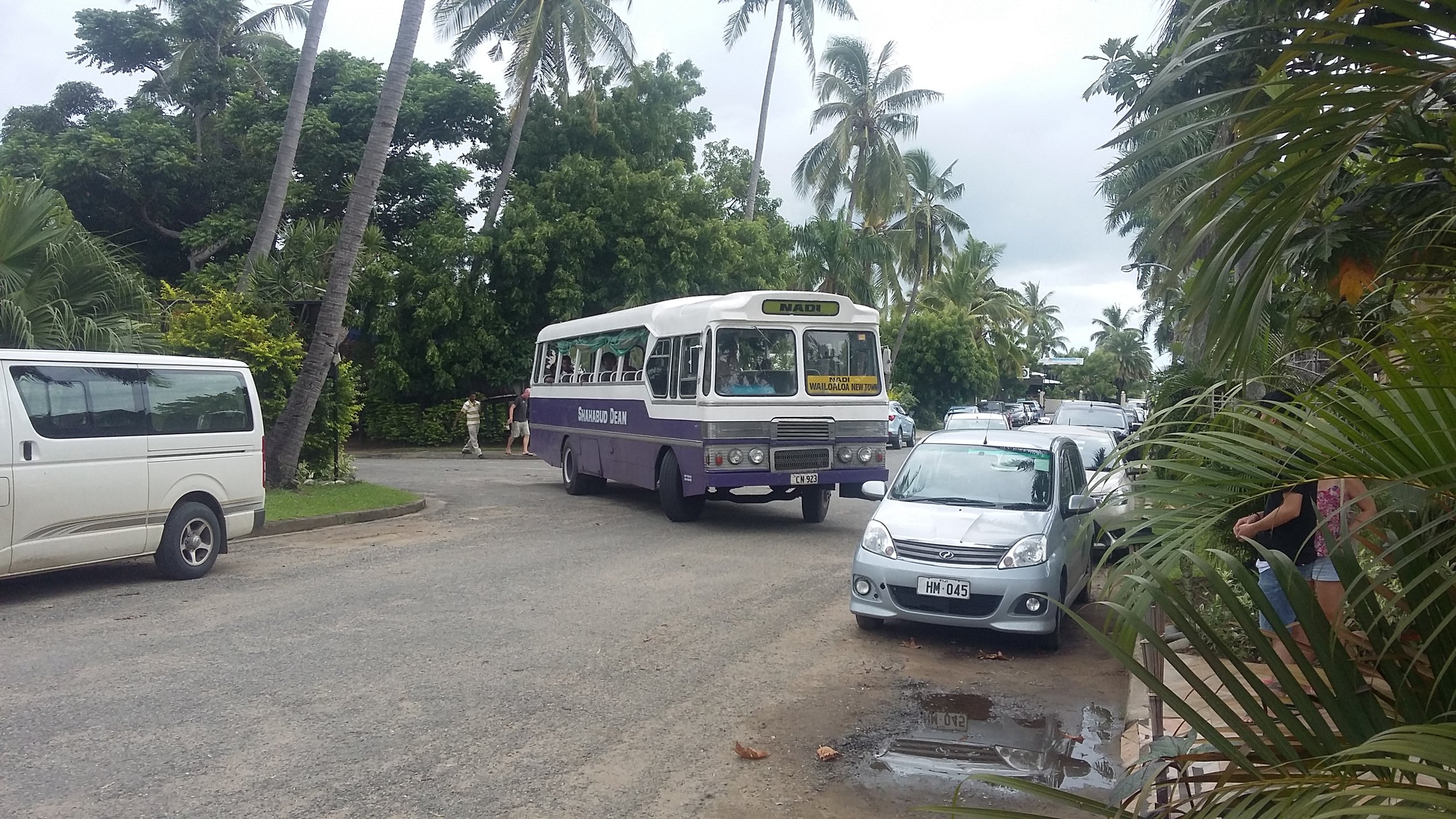
After waiting an hour and fifteen minutes for a bus that never arrived, we eventually hopped on the next one that made its way past. There aren't any apparent public transport timetables in Fiji and the big rusty purple things appear to just show up as and when they please. For $1 a ride, however, we couldn’t complain. And yes, I’m still taking about the busses here and not the local call girls. They are always on time. Or so I’ve heard.

Disembarking at the main bus terminal, the four of us pale tourists were immediately targeted by the locals. One guy started chatting to Connor about taking us on a personal tour of the town centre, and before I even had the chance to dismiss him we found ourselves following his cronies through a fruit market, down a grotty alleyway, up a rickety fire escape, and into a traditional handicrafts shop that looked more like a living room than a place of commerce. ‘Well, we’re here now,’ I thought to myself. ‘May as well see what this guy has to offer.’

Taking off our shoes at the entranceway, we formed a cross-legged circle on the woven rugs that covered the floor. The main guy who had stopped us squatted down and two of his friends sat down on either side.

“Greetings, friends,” he started, shaking all of our hands. “It is tradition for us in Fiji to welcome you to our beautiful country with a kava ceremony. Are you all happy to participate?”

“Cava?” I announced in disbelief. “We’re being welcomed into Fiji with Spain’s answer to champagne? If that’s the case then damn right I’m happy to participate. Bring it on.”

“No,” muttered Connor. Kava, spelt with a ‘k’, is a Fijian root which is ground down into a fine powder and then mixed with water. I had some last night.”

“Was it any good?”

“Even for a liquid that looks like it came from the rectum of someone with severe food poisoning, no, it was not.”

“Lovely.”

On cue, the guy brought out a large wooden bowl and started preparing the mystery potion. There was a long piece of woven rope attached to it with a shell knotted at the end.

“Who’s the oldest here?” he asked, glancing around the circle at the three fresh faces of my companions before resting his eyes on my scraggly, out-of-control, beard and laughter lines.

“That would be me,” I responded.

“As the oldest, you get to be the chief of the ceremony,” he smiled, offering the shell to me. “Having the shell placed in front of you signifies that you are in charge of the proceedings. Now, if you would like to copy me, we will recite some incantations and clap in unison.”

‘Well that that authority didn’t last long,’ I thought.

We tried to keep rhythm with our three hosts as they fished kava from the wooden bowl and made us take turns in gulping down cups of the mucky water. It tasted like feet which had recently trodden in a baby’s dirty diaper. Whilst I struggled to stomach the concoction, however, Connor appeared to be chowing it down; mesmerised by the guy’s chanting and conversation.

“So, you are going to take the Israeli girl back to England with you after this, yes?” he asked Connor casually, pointing at Coral.

“Not quite,” laughed Connor. “We only just met, actually.”

“Well, what about you,” he said, directing his attention towards me. “Are you going to take the Finnish girl back to Scotland with you?”

“Unfortunately not,” I blushed, taking another sip of kava. It’s not alcoholic in any way but does have properties of a depressant drug. This means that it slows down the messages travelling between the brain and the body, causing a numbing feeling around the mouth, lips, and tongue. Everyone started to laugh.

Once the bowl had been near-enough emptied, the guy brought out a tattered poly pocket folder filled with clippings and photographs. “Here comes the sales pitch,” I whispered to Coral.

“I’m assuming that you all heard about the horrific storm that came through here a few years ago and devastated my village?” he questioned, already reciting his spiel from memory.

“A few years ago?” I jibed. “What about the one that came through yesterday?”

“We are still trying to deal with all the wreckage caused,” he continued, not even missing a beat when choosing to ignore my comment. “Here are some photographs of the damage that was caused to our properties and the vein efforts of our tribe to try and repair them,” he said, leafing through the pages of the folder in an attempt sucker us in with empathy. “All of the ornaments and souvenirs that you can see in this place were done by these villagers," he said, casting his arm around the living room. “The paintings were made by the local school children during their art classes and the carvings were all hand-made by the adults. Everything we make from the sale of these products goes back to funding our relief efforts. Don’t feel obliged to purchase anything, but please look around and see if anything takes your fancy. Everything has already been 100% approved by international customs and you can take it to any country in the world.”

With the closing of this epic speech, Johanna, Coral and I nodded our gratitude, slipped our shoes back on, and headed back out into the humid afternoon. “If I stayed in there any longer I’d have started questioning him as to why the locals decided to waste their time carving wooden elephants and doing finger painting as opposed to actually undertaking the much-needed repairs,” I yawned. “Anyone fancy going to get some food? I need to wash away the taste of that kava from my mouth.”

“For sure,” said Johanna. “We just have to wait for Connor. He’s still inside having a look around.”

Five minutes elapsed, in which we stood uncomfortably on the balcony staircase, before Connor re-appeared from the Aladdin’s Cave of tat. “Hi guys,” he smiled, stuffing a plastic bag into his rucksack upon exiting. “Cheers for waiting. That’s my mum’s birthday present sorted. Now, who fancies some food? I’m starving.”

I can’t believe you splashed out $45 on a wooden turtle with the word ‘mum’ carved into the bottom of it,” I scoffed whilst trying to keep down my chicken fried rice, “or believed the bullshit that he spat about the money going to rebuild his community.” We were sat in a bustling Chinese restaurant just around the corner from the scene of the crime, tucking into massive $5 portions of food.

“Well, ‘Melanie’ has more letters so would have been more expensive,” he reasoned in defence, trying to justify his purchase whilst poorly hiding the fact that he’d clearly spent way more than anticipated on the gift.

“It’s not a football top, I laughed. You don’t get charged by the letter.”

“Ah well, I think she’ll like it,” he said. “Oh, and that reminds me. I was planning on getting one of those Hawaiian shirts that all the Fijians seem to wear and making a short happy birthday for her. Would you guys like to be in it?”

“Absolutely,” we chimed in unison, finishing our food and paying the bill.

Heading back to the bus terminal, we swung by the Buddhist temple that sat proudly in the centre of the town. For the $5 entrance fee, however, I wished that I’d just had a second course at lunch. The guy who showed us around told us that it was the second largest temple of this religion in the Southern hemisphere and that it cost $15m to construct. My inner atheist boiled up at the thought of all that wasted money. There was a half-collapsed village around the corner that needed help for Christ’s sake. Even with backpackers like Connor spunking $45 a time on carved animals, it would take a hell of a long time to raise that much money.

“You look like a middle-aged American man about to take his kids on a forced and far too organised caravanning holiday,” laughed Johanna as I donned my new purchase on down on the beach that evening. Connor and I had snapped up a pair of red floral shirts for $20 a pop and were in the process of harmonising our voices for the rendition.

“You do as well,” nodded Connor. “You can’t deny it.”

“Do you want me to be in your video or not,” I retorted.

“Yeah, let’s get it done now whilst the sun sets.”

Giving his phone to one of the hostel staff members, who was randomly sitting on an upturned boat and gazing out to sea whilst holding two coconuts, we belted out a happy birthday to his mother whilst a pack of rabid dogs tried to drown us out. The video was a complete train wreck, but the vista behind us made up for the amateurish element of the content. After all, it’s the sentiment that counts. What you couldn’t tell from the video was the horrible stench that emanated from the beach and the piles of rotten driftwood and rubbish conveniently hidden off-camera.

Back in my dorm I ripped off my shirt and threw it in the bin. The next day I was going island hopping and, although sad to be leaving my new companions, quietly couldn’t wait to get away from that dirty seaport town.
A Fijian Tropical Storm

Nadi, Fiji • February 2017 • Length of Read: 7 Minutes

My head was buried in a book when I received the tap on the shoulder that I’d been dreading. It was bound to happen sooner or later, but I’d hoped to have at least made it to the end of the chapter I was on first. A wry smile had spread across my face upon receiving my boarding pass from the Fiji Airways check-in desk at Auckland airport. Seat 19A. A window seat. Perfect. Peace and quiet for three hours with nothing but the billowing clouds blanketing the Pacific like double-spread duvets for company. Evidently not. Bliss shattered.

“What are you reading?” asked the woman sitting beside me as I turned to face her. The seatbelt signs had only just been switched off, but even before we’d reached cruising altitude she had already been up and down three times. At least I hadn’t been given aisle seat 19C. She was middle-aged, but a youthful hippie aura emanated from her.

“It’s about the evolution of homo sapiens, charting their spread throughout the world whilst analysing how the cultural, political, and religious structures that we’ve developed as a species have come to define us as humans,” I responded, answering her question. “Can I ask why you kept getting up and down at the start of the flight?” I continued, curious. “Are you a nervous flyer?”

“Oh no, not at all. I just decided that it was better to eat my snacks at the back of the plane. I brought a lot of smelly cheese onboard and didn’t want to suffocate the rest of the passengers, so I went to the toilet to spread it on my crackers. It’s also not the nicest thing to have to watch someone eat either,” she joked, reading my bemused expression.

“That’s not what I was expecting,” I chuckled. “I suppose I should thank you for being so courteous, but I’m a bit jealous that I didn’t get to try any of it.”

“Do you want to have a sniff of the bag?” she offered.

“I’ll pass.”

A Kiwi by birth, Steph had been living in Los Angeles for nigh on eleven years. She had been back in New Zealand visiting her sister and was laying over in Fiji before catching a connecting flight to the US. Being served our in-flight meal, we spoke about literature, previous trips we’d taken, life, and love. She was a yoga instructor who definitely had a gypsy heart, and I was awed when she told me that she’d recently slipped on a naughty negligée and gone to a party at the Playboy Mansion. I felt bad that I’d initially tried to subdue the chat. If you’re reading this Steph, then thanks for making my flight pass with such brilliant conversation. Your inner L.A. diva did, however, make an ever so slight appearance when the polite flight attendant came around to collect our food and rubbish.

“You need to stow away your table as we prepare for landing,” reasoned the burly, mild-mannered Fijian. His colourful Hawaiian shirt uniform looked both professional and chill. “Can I please take your food tray?”

“But I’ve not finished it yet,” argued Steph, pointing at the untouched foil over her vegetarian curry.

“Well, you can’t eat it on the plane anymore as the captain has now turned the fasten seatbelt signs back on for our descent.”

“Can I not take it with me then?” she pleaded.

“You’re not allowed to eat it in the terminal building, I’m sorry”

“I’ll eat it before.”

“I quite doubt that,” he said, picking up the tray and continuing along down the aisle. He’d clearly had enough. As the plane touched down, I said my goodbyes to Steph, shuffled along the aisle, and laughed. Travel never stops to amaze me with all the awesome people that it exposes you to.

Queueing at border control, the passengers were all greeted into Nadi with a reception from a traditional Fijian band. At what stage they start getting fed up of playing the same songs over and over again to new arrivals of gawking faces I do not know, but it certainly wasn’t on this afternoon. Don’t ask me why, but despite being on the opposite side of Fiji’s main island from the nation’s capital and largest city, Suva, Nadi is the principal location of entry for air travellers to Fiji. Shuffling forward, I got my passport stamped with barely a glance, plucked my rucksack from the baggage claim conveyor belt, and exited out into the arrivals hall. There, for the first time ever in my life, stood someone waiting with a sign.

Despite only paying $16 per night for a bed, Bamboo Backpackers had offered me an airport pick-up and I was not shy in saying yes. My driver, Neil, was infectiously happy and welcomed me with a huge ‘bula’. As with ‘aloha’ in Hawaii, ‘bula’ literally means ‘hello’ in Fijian, but it has practically been adopted as a catchphrase by the country’s residents, who I would soon find out all had the same upbeat approach to life as Neil. The island-hopping boat ticket you can purchase is called the ‘bula pass’; the locals have a campfire song called ‘the bula song’, and, when sung, this is accompanied by a choreographed ‘bula dance’.

I hopped into the front seat of Neil’s mini-van and we raced through the hedgerows towards a very dark sky, bantering about culture and sport. I asked him what the reaction was like in Fiji when their men’s rugby sevens team won the country’s first-ever Olympic medal in Rio 2016, taking gold. “We partied for a fortnight straight,” he responded with a big grin as we pulled onto the street where the hostel was situated. “It was loco. It was crazy.”

Checking in at reception, I lugged my bag along a corridor and through the door of the four-person dorm that I’d been allocated a bed in. Although it was only 7pm, a girl was in there taking a nap and she stirred from her sleep as I entered. Johanna hailed from Finland and had arrived that morning. We chatted shit for a while as I sorted out my stuff before our rumbling stomachs told us to head out for some traditional Fijian food. Clinking beers, we entered into a lengthy conversation whilst waiting for our dinner to arrive.

Fijians operate around a concept known as ‘Fiji time’, which loosely means: ‘Don’t worry about the time. Things will eventually get done, and if they don’t then it’s not a big deal anyway.’ You’ll be hard-pressed to find a clock anywhere and the locals will rarely wear watches, preferring to operate like it is pre-time immemorial. The hostel reception and kitchen were both open 24/7 and, because there is no time, you can never be late for anything. The public transport network must be loving that timetable: ‘The next bus will arrive on Fiji time. Exactly when it means to.’

That reminds me of a joke I once heard on daytime radio:

Q) Why are London buses always red?

A) Wouldn’t you be if you had to come every ten minutes?

Maybe that’s why Fijians appear to always be so happy, because they are never stressed out about getting something complete or rushing around thinking that they are going to miss an appointment or deadline.

It might also be the reason, however, why every building that I’d passed since leaving the airport seemed to have been abandoned mid-construction.

Eventually, Johanna’s grilled fish and my beef coconut curry arrived, and they were absolutely delicious. We scoffed them down, wiped our plates clean, and, as the heavens began to open, sprinted back to the sanctuary of the dry hostel bar. Dry in the weather sense, that is. It was far from dry when it came to alcohol.

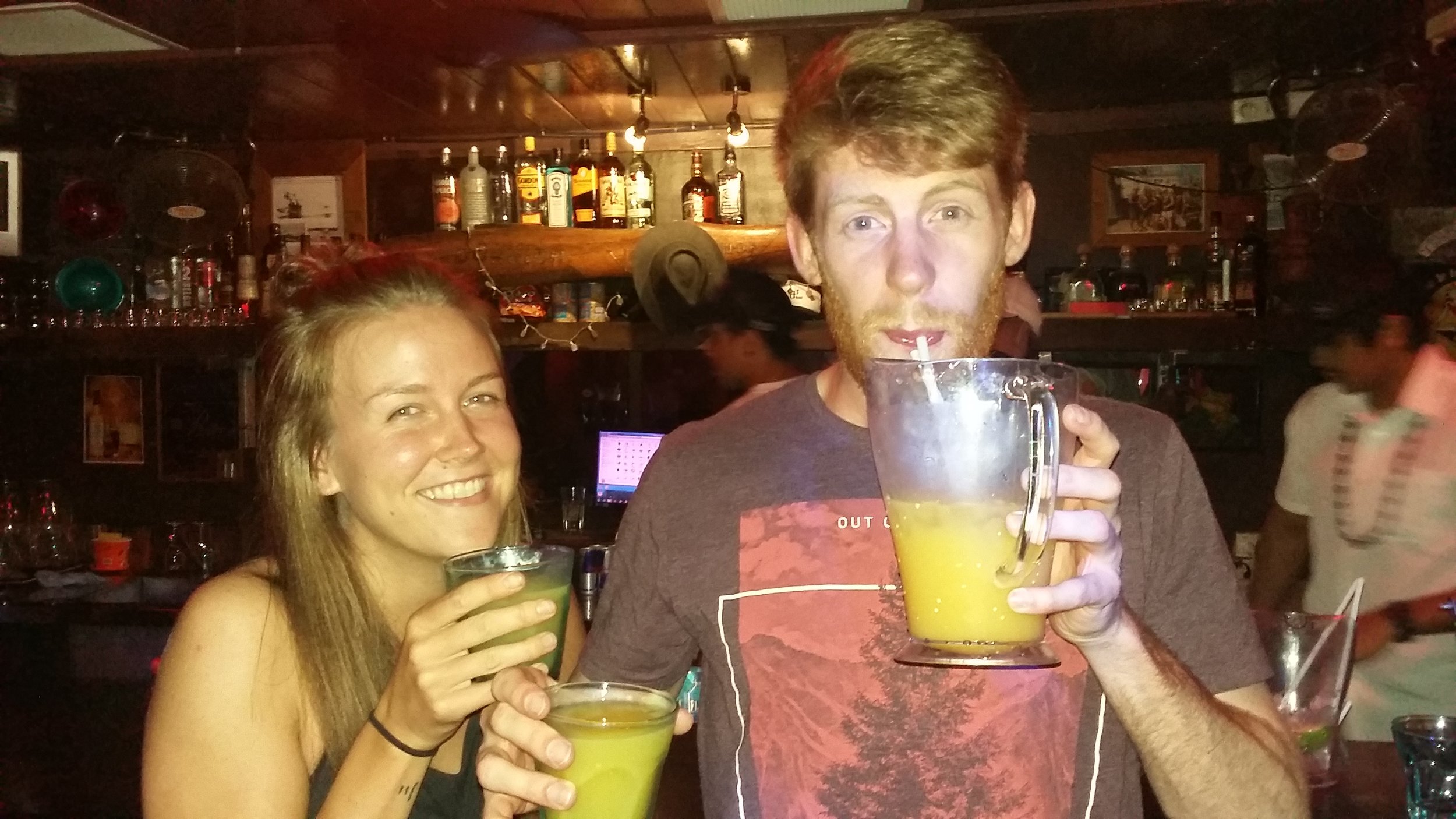
We ordered a couple of pitchers and, sitting down at one of the long wooden tables in the sheltered area by the pool, got chatting to an expat called Andy Fritzel. He told us that the biggest tropical storm in ten years was scheduled to hit the mainland the very next day.

“Excellent,” smiled Johanna.

“Yeah, it’s been a downpour all week,” he sighed, sombrely. “Quite a few of the boats have been cancelled and one even capsized a few days ago.”

“Well, we’ll just have to wait it out,” I reasoned. “What is there to do here whilst sitting under God’s toilet?”

“Drink, of course,” shrugged Andy, like there was only ever going to be one answer to that question. “I’ve got a car by the way,” he added, directing his gaze to Johanna, “so if you want a lift anywhere then just let me know. I said to one of the other girls at the hostel that I would take her to the cape tomorrow night to see the sunset, weather permitting. It can be dangerous out there, but I’ll keep you safe.”

“I bet you will,” I thought to myself, taking a long sip of Fiji Gold beer. “I’m sure all girls are safe when riding in the back of that creep waggon of yours.”

As the rain battered down, I smiled at the absurdity of where I was. Sat at a beachfront bar, palm trees lining the golden sands being lapped by the ocean, traditional music echoing from a group of locals sat cross-legged in the corner, and the weather worse than back home in my native Scotland. I suddenly felt the urge to get very, very drunk.

Top 5 of 2016 - A Crobs Abroad Year in Review

Glasgow, Scotland, UK • December 2016 • Length of Read: 2 Minutes

36.jpg

The general consensus seems to be that 2016 has been a pretty shit year and rounding up some of the world events that have taken place over the past twelve months, then, yes, I could see why people may think so. There have been a seemingly mounting number of terrorist attacks; political upheavals; refugee crises; Olympic debacles; doping scandals; and a string of celebrity deaths including David Bowie, Prince, and, most recently, Leonard Cohen.

The truth is, though, we are still living in one of the most peaceful times in history. The reason that we are all seeing the world as this horrible place full of death and destruction is due to the vanishing information communication gap. Nowadays, if something ‘bad’ happens, no matter whereabouts on planet Earth, the media will make it their duty to spread this over every mobile app, newsfeed, and website they possibly can. They are all about the fear mongering, because that it what sells. In reality, it’s not that these attacks and tragedies are on the increase, it’s that previously we were just oblivious to their happening. I'm not saying that 2016 is without its flaws, I'm just saying that it needs to be put in perspective.

Personally, I think 2016 has been a fucking great year.

I rang in the New Year by shooting assault weapons at an old military rifle range in Vilnius, Lithuania. Here, I befriended two crazy blondes who would change my life more than they will ever know. During a manic period at work, I managed to sneak away to Copenhagen, Denmark with them before launching my first paperback book, Crobs Abroad: A Scot’s Misadventures with a Backpack. To celebrate this, and my 25th birthday, I then hit up Reykjavik and New York City for a summer holiday.

A trip to Vienna, Austria in July gave me the chance to catch-up with two friends who I hadn’t seen since living with them in Maastricht, The Netherlands four years prior. It also sparked a deeper connection with an Italian girl I’d met in Riga, Latvia over eighteen months before. The pair of us would go on an autumn road trip through the Balkans and then meet again in Prague, Czech Republic for a winter getaway. These trips combined to form my second publication, We Ordered a Panda: Tales of City-Hopping around Europe.

It’s sometimes those experiences closer to home, though, that really shine through and my weekend spent camping in the Wimbledon queue to get tickets for Centre Court has to be the surprise package highlight of 2016 for me. We met some great people and I can’t wait to do it all over again in the future. It’s something that could very easily become a tradition.

The year rounded off with me leaving my job, packing my life in a rucksack, and starting a world tour down under in Sydney, Australia. Over the course of 2016 I’ve visited 10 different countries, crossed off 7 bucket list items, and created lifelong memories and friendships.

Yeah, by my accounts, 2016 has been a pretty fucking great year. Here are the Top 5 experiences:

  • Firing Assault Weapons at a Rifle Range [Vilnius, Lithuania]
  • Camping out in the Wimbledon Queue [London, UK]
  • Bathing in the Blue Lagoon [Reykjavik, Iceland]
  • Visiting Time's Square [New York, USA]
  • Being Reunited with my ERASMUS Buddies [Vienna, Austria]

Thanks for reading and let's make 2017 even better ;)

What Do You Want to Be When You Grow Up?

Glasgow, Scotland, UK • November 2016 • Length of Read: 4 Minutes

It’s a question that every child gets asked. A question that fills them with excitement and sets their imaginations running wild. And whether it comes from a teacher, a parent, a peer, or even an overly fussy distant friend of an aunt, they are rarely afraid of giving an honest answer. ‘Unrealistic’ isn’t a word many children associate with. After all, this question is usually preceded by a statement indicating that ‘when you grow up, you can be whatever you want to be’. The sky isn’t the limit, the edge of the Universe is. I vividly remember Mrs Leslie asking us this in primary school. I must have been six or seven years old at the time. She stood in front of the class and said, What do you want to be when you grow up?” An open-ended thought that brought with it endless possibilities.

“A fireman,” yelled out one of the boys at the front.

“A nurse,” added a girl to my left, enthusiastically.

“A spaceman,” said my best friend.

Somewhere along the line, though, these desires fade. Reality takes over. We lose passion. We get side-tracked by the monotony of daily life and short-term thinking. Doubt creeps in. Dreams are suppressed to when we are asleep. As an experiment, I recently posed this to a work colleague of mine. The response was a bemused and confused wrinkle of the face followed by the statement, “I’m not a kid anymore. But I suppose when I was younger I wanted to be a veterinarian.” Wanted. A verb used in its past tense.

Yes, people change. I understand that. And something you wanted to be ten years ago may now be something that genuinely doesn’t interest you. As we learn new things and grow as individuals, different influences and wishes take over. This is why it is so important to keep asking yourself this question. What do I want to be when I grow up? I don’t care if you’re eighteen or eighty. Until you are dead you should still be wanting to pursue new things. Why should fantasising and dreaming about our future lives be constricted to only when we are children? I’m a 25-year-old 'man' and still get a kick out of what some may consider ‘unattainable’ thoughts and ideas. As far as I’m concerned, if something is deemed to be unattainable, then it’s all that more exhilarating and exciting when you finally achieve it.

My response to Mrs Leslie’s question? – “I want to be an explorer.”

As I head off next month on a tour of Oceania and Asia to compile stories for my sophomore travel book, this ‘dream’ is now very much still a reality. It’s a goal, I suppose. And what are goals but simply dreams that have timelines attached?

So ask yourself today, tomorrow, and the next day: What do I want to be when I grow up? You’ll probably be surprised with what your brain comes up with…

The Most Remote Place on Earth

Tristan da Cunha, UK • November 2016 • Length of Read: 4 Minutes

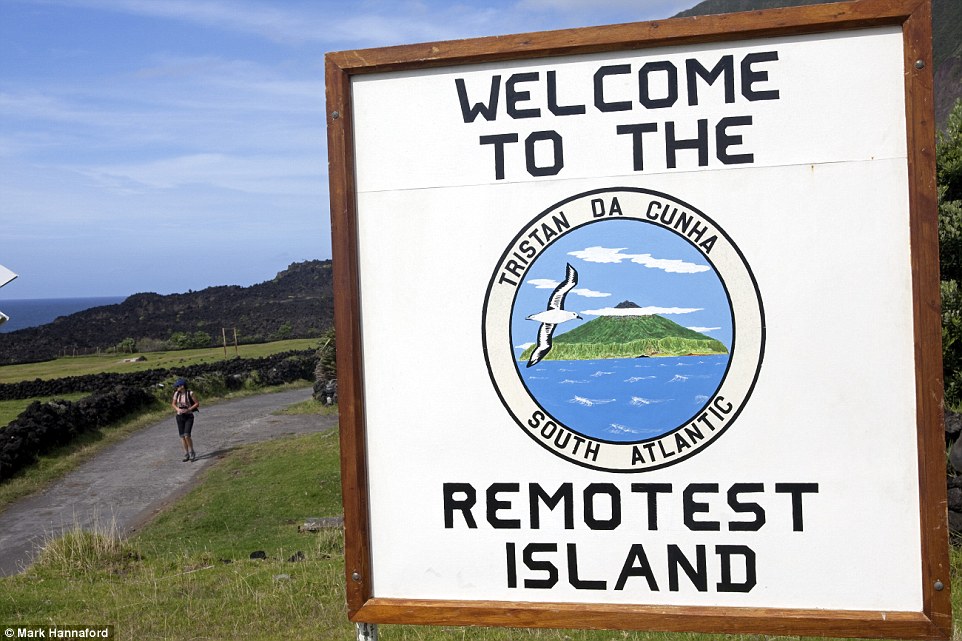
2,400km west of Africa, and 3,360km east of South America, lies a group of volcanic islands which are the most remotely inhabited place in the world. Tristan da Cunha was first sighted in 1506 by the narcissistic Portuguese explorer Tristao da Cunha, who was egotistical enough to name the main island after himself. The sole settlement of this southern Atlantic Ocean archipelago is located here and is home to 265 permanent residents, most of whom are fishermen. It is called Edinburgh of the Seven Seas. The people that reside here are 2,173km from the next nearest human settlement, Saint Helena, the British overseas territory it is a part of, and they refer to their home simply as: The Village.

Edinburgh of the Seven Seas was founded in 1816 by a Sergeant from the Scottish Borders, and was given its name after Prince Alfred, Duke of Edinburgh, visited the UK annex in 1867. It has a post office, a small port, and a military garrison that was disbanded at the end of the Second World War. This had initially been set as a defense when Napoleon was imprisoned in St. Helena. There was also a crayfish factory, but in 1963 this was destroyed by an Earthquake which forced the residents to evacuate to England until the settlement was re-built. With no airport, the only way to get to the island is by shipping vessel from Cape Town, South Africa. Permission also has to be granted before travel.

Most comically are the selection of vehicles on the island. The ambulance service is single a Toyota Hilux, the fire engine a Land Rover Defender, and the police car another Land Rover. The Village also has a bus service called the Potato Patches Flier. This is a 24-seat Isuzu mini school bus that was brought over from South Africa and allows the residents to travel around the islands only road - the M1. There is one shop, one school, one TV channel, and what settlement would be complete without at least one place to get a drink.

I quite fancy having a pint one day in the Albatross Inn, the most remote pub on Earth, and learning from the locals what life is like at the end of the world. That’s if I can understand their curious 18th Century seafaring English dialect. Apparently it also does a pretty tasty lobster quiche if you’re feeling peckish.