How to Sneak into the Vienna State Opera

Vienna, Austria • July 2016 • Length of Read: 10 Minutes

The following extract has been adapted from my self-published paperback travel book, We Ordered A Panda: Tales of City-Hopping Around Europe. If you enjoy this post, then please visit my online bookshop for more details.

Shaking off two large hangovers, the result of a night spent adhering to Vienna’s absurd drinking traditions, Lara and I met Lukas for a leisurely Saturday brunch at the Zweitbester Café in the Austrian capital’s 4th District. My old flat-mate had offered to act as a local tour guide for the weekend, and taking his self-appointed role very seriously, came strolling round the corner with a guidebook in hand; a proposed agenda for the day already mapped out in his head.

As I tucked into a lovely dish of eggs benedict, Lukas suggested that we first take a stroll into the Innere Stadt of Vienna, where the majority of sites and attractions are situated. Enclosed by a ring-road, one could briskly walk across the diameter of this 1st District in about 20 minutes, but the number of fascinating buildings and places within this map-dot means that it will more likely take you in the region of 4 hours to complete the trip. Between getting purposefully lost in the maze of back-alley cobbles; to the premium pedestrianised fashion avenues; to the museums, monuments, and cafes, this area is a cultural hub that showcases a well-preserved timeline of the city’s development and influences over the centuries.

The Habsburg Monarchy has been the most consistently influential power in the region since the signing of the Treaty of Vienna in 1515. Through marriage, this dynasty ruled a vast portion of Europe within the Holy Roman Empire, with the head of the Austrian branch of the House of Habsburg acting as Emperor. Vienna was their capital from 1526-1806, aside from a brief 28 year ousting to Prague, and their Swiss origins, at the turn of the 17th Century. Knowingly over-simplifying proceedings, and at the risk of deploring my own ignorance, there appears to be three prominent figures from this long line of descendants who have shaped the landscape more than any others, both politically and physically: Franz Joseph I; his wife, Empress Elizabeth (i.e. Sissi); and Rudolph IV. Okay, enough of the history lesson.

Think of Franz Joseph as the star of the show for our little journey, with Sissi as his leading lady. Both are buried in the Imperial Crypt, along with 145 members of their ancestry, and for €5.50 you can wander between the exorbitant sarcophagi and pay tribute to the deceased. As we would find out, this unusual price seemed to be the going rate of entry for nearly every tourist attraction in the city. The pair have been placed side-by-side in death, and the numerous fresh bouquets of flowers and token gestures littered around their headstone plaques signified how adored they still are, a whole century after their passing. Rudolph IV on the other hand, who lived a full 500 years before this power couple, is buried in a different crypt under St Stephen’s Cathedral. Now we have some background, let the tour truly commence…

Of Vienna’s top-5 architectural behemoths, the Cathedral stands out like a dagger in the heart of the city. The construction of this was initiated by Rudolph IV, but will sadly never be completed. One of the Cathedral’s two towers stands stump-like in contrast to its grandiose sibling, but that takes nothing away from the beauty and scale of this medieval place of worship.

After wandering through the catacombs of this structure, a well-to-do tour guide spitting facts at us for €5.50, we decided it might be a good idea to get some sunlight. Meandering around the tourist precinct we stumbled across a philosophy-centric book shop, before Lukas navigated us in the direction of his favourite hang-out, Klein’s Café. My other ex-flatmate Steffi joined us, having taken her 92 year-old grandmother out for a birthday lunch, and re-fueling with some Austrian sausage we caught up on the prior evening’s escapades. 'Now this is acting like locals', I thought to myself.
“Have you guys thought about going to the Vienna State Opera this weekend?” she asked, still giggling from my admission that the Dutch girl from the night before might have been more interested in her than myself.

“We were thinking about it, but it seems rather expensive for something we probably wouldn’t enjoy.”

“It’s only expensive for those who don’t know a few local tricks,” she grinned in response. “Let’s go and see if we can sneak in the back door.”

We headed down the street and past Hotel Sacher, the residence where the world famous Sacher Torte chocolate cake was born. Seffi explained that when tours of the Opera hall are in progress, or a concert is taking place, the outside doors to the building are all unlocked so that the staff members can move freely throughout. This means that you just have to time your entrance as being directly after one of these instances has gotten underway, and you are free to wander around the entire place. Sure, you’re not going to get front row seats for a five hour Mozart symphony, but you will be able to take in the atmosphere without spending the €50 entrance fee.

Unfortunately for us, Steffi’s timing was slightly awry, and when we eventually arrived the final tours had finished for the day. Unperturbed by this, or the rain which had started to beat down, she decided instead to take us to the Hofburg Palace. This would have been Franz and Sissi’s winter home, with their summer home being the enormous Schönbrunn Palace to the West of the city. Schönbrunn has over 1,400 rooms, and was where Franz Joseph was both brought into the world, and taken from it. Lara and I explored the mesmerising grounds of this estate the following day, the vastness of them allowing for ample peace and quiet, despite the thousands of tourists filtering through the grand entrance way that makes it the most visited attraction in the whole of Vienna.

As with the Opera, Steffi was convinced that if she tried enough of Hofburg Palace’s external door handles we would be able to get access to the Marble Hall and gold-tinted corridors. Alas, this was to no avail. Then it was the turn of the library enclosed within the University of Vienna to have its doors rattled, an establishment also founded under the guidance of Rudolph IV, followed by the storm gate of a house where Mozart once resided. The initial professionalism of Lukas’ tour guiding abilities was being shunned by this girl’s desire to break-and-enter into every building of prominence in her hometown. The only advice I can offer from our efforts however, is that cat burglars should consider pulling off jobs elsewhere. Apparently the Viennese people like to keep their properties rather tightly secure.

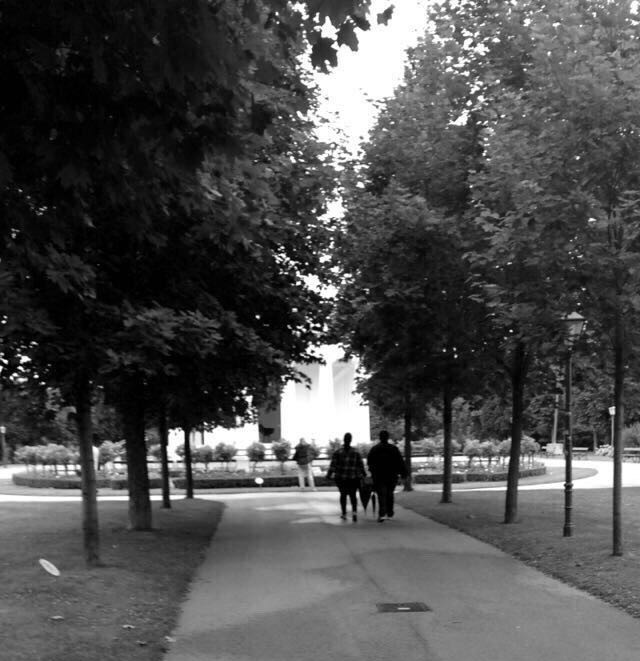
Hofburg has two primary gardens, and re-tracing our steps towards Café Landtmann, where we planned to get an early evening coffee and rest our weary legs, Steffi gave us the option of walking though one or the other.

Volksgarten is the larger of the two, and is the one used by the more common people,” she half-joked. “Burggarten has a lovely little lake, and is where the more middle/upper class people tend to hang out. Each weekday morning, the horses from the Palace’s Spanish Riding School parade around this garden in a public display. Which one would you prefer?”

“The commoners' plot of dirt would be better suited to us," I acknowledged, glancing at Lukas who nodded in agreement.

We strode past a gallery, where a model of a naked man hunched over in a stranded rowing boat left us bewildered and confused. Contemporary art has always been a mysterious beast to me. I remember vising the Tate Modern in London once upon a time, and struggling to figure out whether the mop and bucket lying in the corner of one of the rooms was some form of creative statement, or simply the cleaner having failed to tidy up.

After some delicious cakes, served by waistcoat and bow-tied waiters, Lara and I bid farewell with a massive thanks to Steffi and Lukas. The pair had been the best aides we could have hoped for, and although orthodox in their actions could definitely have pulled off the guise of proper tour guides. Lukas was able to regurgitate facts and dates like he’d been studying for an exam, and Steffi added some personal flair to the proceedings that only someone who'd spent their whole life in the city could have. I just had one small peeve...

As we headed back towards the apartment, Lara noticed a tacky souvenir shop with a postcard reel outside. Twirling it round whilst looking for something suitable to send to our Russian friend Ksenia, she noticed one that had a close-up image of a bustling Klein’s Café. Our lunchtime pit stop, which Lukas had ensured was known only to the locals, appeared to be one of the trademark eateries in the whole city. I guess we'd been no more than typical tourists after all.
Vienna's Absurd Drinking Traditions

Vienna, Austria • July 2016 • Length of Read: 5 Minutes

The following extract has been adapted from my self-published paperback travel book, We Ordered A Panda: Tales of City-Hopping Around Europe. If you enjoy this post, then please visit my online bookshop for more details.

A 16 minute journey from Vienna International Airport on the City Airport Train (CAT) takes you directly to Wein Mitte Station, and the Landstraße U-Bahn. Here, one can hop on either the U3 line, which runs across the Austrian capital’s 1st District from the North-West to the South-East, or the U4, which comes down from the North before curving to the South-West and in the direction of Schönbrunn Palace. The Viennese public transport system of subways, trams, and trains, primarily operates on an honesty system. This means that it’s not only one of the most convenient and easy-to-navigate commuter service in Europe, but also one of the cheapest (i.e. it is free).

Fours stops along the orange coloured U3 line, I exited at Erdberg Station to find Lara waiting for me in a lonesome little café outside the Vienna International Bus Terminal (VIB). One of the stars of my book, we’d shared previous adventures in both Riga and London, however this was the first time we’d be exploring a brand new destination together. There’s nothing like that feeling of warmth that rises up through you when meeting an old friend. It really does tickle the heart. Upon seeing one another, you invariably end up bursting into coat-hanger wide smiles, before trying to squeeze a year’s worth of happiness into one almighty bear hug.  We only had one hour to get the keys for our apartment however, before a scheduled 9:30pm drinks session with a couple of very special local guides, so I grabbed her suitcase and we immediately hopped back onto the U-Bahn.

Serbian happens to be one of a mere eight languages that Lara speaks, my monolingual upbringing a pure embarrassment in comparison, and this was very handy considering our landlord for the long-weekend went by the name of Stonka. As the women ran through the rules and regulations attached to our visit, I tried my best to entertain the apartment owner’s young child, who was obediently heeling beside her mother’s leg like a puppy. Upon merely smiling at the little girl however, she burst into tears, like some monster had jumped out from being the front door and tried to eat her.

Stonka finished the tour of our abode and left us to unpack our stuff, the kid still looking shocked from the ordeal. After a quick change, we followed her right back out the door towards the Kettenbrückengasse U-Bahn Station. Here, four years after living together in Maastricht, The Netherlands, I was reunited with my Erasmus buddies Steffi and Lukas.

“You’ve not changed a bit Crobs,” beamed Steffi, as she rounded the corner. “Well… perhaps you’re a little bit skinner than before. Have you stopped going to the gym?”

“With no Julia around anymore, the motivation has kind of dwindled,” I laughed. Whilst in Maastricht, I’d developed such a severe crush on the German abs instructor that it led to me attending five classes per week just so I had an excuse to chat to her. Nothing ever came from these flirtatious gym sessions however, and after four months of chasing all I had to show for my vein efforts was a well-defined six-pack.

Lukas arrived, and we took a trip down memory lane whilst clinking glasses atop the skyline bar of the 25hr Hotel; a lit-up panorama of the cultured cityscape the backdrop to our nostalgic musings. He explained that we were currently in the city’s 7th District, of which there are 23 in total. The 1st District is the nucleus, and is where everything touristic is situated: from the Hofburg Imperial Palace and its spacious gardens; to the Opera; to the University, the City Hall, the Parliament Building, and the Sacher Hotel. A ring-road signifies the boundaries to this Old Town, with Districts 2-9 lining its circumference. Steffi joked that the gay scene was situated in the 5th District, which just so happened to be the same area in which Lara and myself were staying.

Wanting to make the most of my friends’ local knowledge, Lara and I asked Lukas and Steffi to take us to a ‘traditional’ Viennese bar. Twenty minutes later, we therefore found ourselves hunched around an antique table in a smoky haze; 70’s classics blaring out from the jukebox tucked in the corner. The décor of Café Bendl could be kindly described as ‘vintage’, and appeared to have not been updated since its doors first opened in 1884. As Lukas came back from the bar carrying a tray of shots, I felt like I’d not only gone back in time to my University days, but back to a place that time forgot. The type of place you would pop in to have ‘one more drink for the road’; the type of place you could get into a heated but amicable philosophical discussion; the type of place where you are admired for being unashamedly yourself, and ridiculed for trying to ‘fit in’. It was all we could ask for, and more.

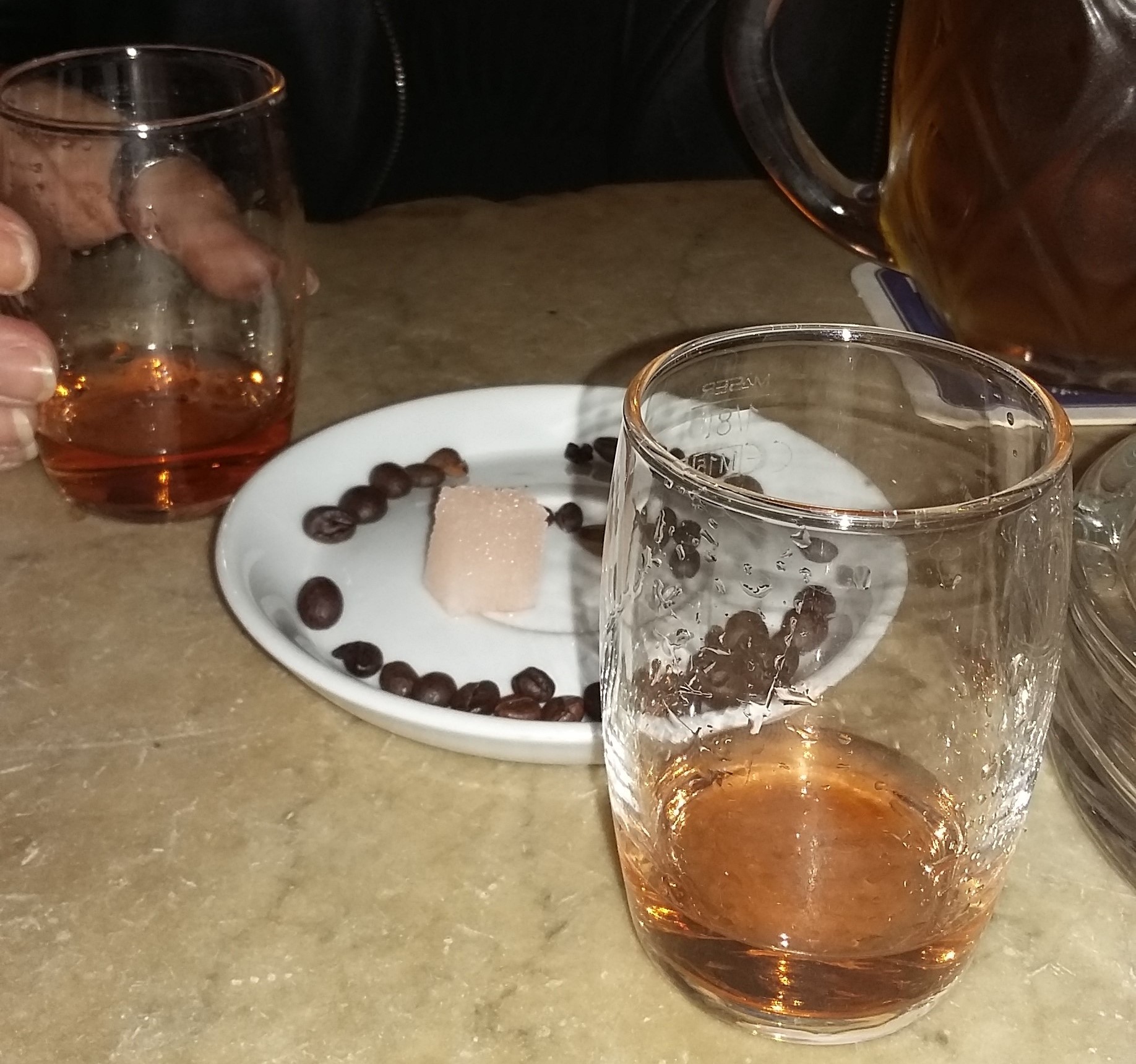
“What on Earth have you got us?” I asked Lukas as he placed a glass in front of each of us, followed by a tray of sugar cubes and coffee beans.

“Ah, cocaine,” exclaimed Steffi. “Well, it’s not actually cocaine,” she continued, seeing the expressions of disbelief on our faces, “but that’s what these drinks roughly translate into English as, from the German word: koks. First, you take a sugar cube and dip it into the shot of red rum. Then you chew and swallow the sugar cube, followed by a handful of coffee beans. When you’re almost done, knock back the shot, and finish the remainder of what’s left in your mouth.”

“Sounds delightful,” I said, raising my glass for a toast. “Prost.”

“Prost,” chimed everyone at once, and we took the shots with grimaced faces.

Gulping at my pint like a goldfish in an attempt to chase away the taste, a beer mat then hit me square on the forehead. Looking to my right, I saw two guys and a girl giggling away in a corner booth. As I was distracted by this, another beer mat then hit me on the back of the head. I glanced in the opposite direction and a group of lads at the other side of the room were trying to hide their smirks at the bottom of their drinks. Had I become the subject of some local joke?

“We probably should have explained,” said Lukas, seeing the puzzled look on my face. “It’s tradition in Vienna to throw beer mats at other tables when in a bar or pub. A way of striking up a conversation if you will.”

I was about to call ‘bullshit’ on this when, in comedic timing, the octogenarian barmaid started to join in. I don’t know if I was more shocked by this act, or the fact that she’d abandoned her position behind the beer taps to sip tequila with some of her patrons. Apparently she’d been manning the bar for decades, and was quite a straight laced individual, but in this instance that façade was completely broken.

“Well, I wouldn’t be trying it in any other dive bar apart from here,” chipped in the German guy to my right, “unless you wish to be on the receiving end of a punch.” Ironically, he was in the midst of an Erasmus exchange program to Vienna with the Dutch girl and German guy who accompanied him. “It’s more a tradition set solely in this bar.”

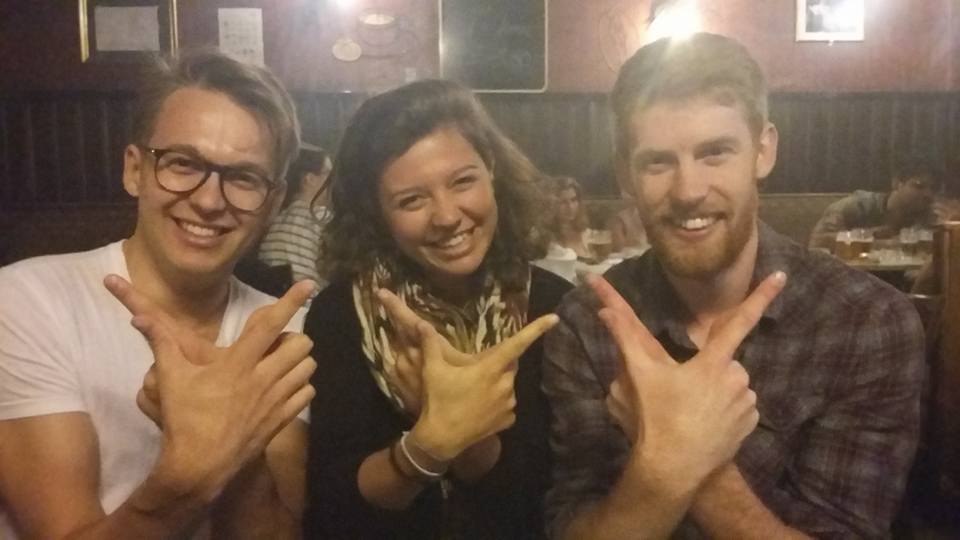
Finding this the funniest thing in the world, Lara and I immediately joined in. Enrolling the help of the Erasmus lot, we entered into a full-blown battle with the lads at the other side of the room. Ducking and diving between sips of our drinks, like it were a game of dodgeball being played with ninja throwing stars, time ticked into the early hours of the morning. And for all my hours spent in the watering holes of the world, a better way of striking up conversations with strangers I’ve yet to come across.

Entering into the spirit of our surroundings, I soon found myself in a deep deliberation with Flora, the Dutch girl, over the meaning of travel and human beings' over-arching desire to explore the unknown. Like most other bar conversations of such nature and magnitude though, our concise and coherent points were soon crushed like the sugar cubes before us into a slur of sounds. The topic naturally progressed to more intimate affairs, and upon finding out details of Flora's liberal nature I couldn't help but blush.

As the shadows of drunkards slid past the window, heading home from the haunts they had been occupying that Friday night, the drinks kept flowing in Café Bendl until sunlight started to crack through the black sky. Operating under a ‘last orders is when the last person wishes to leave’ rule, it wasn’t until we’d then tried some of the kitchen’s fluffy Kaiserschmarr'n pancakes, and realised that we may have had one-too-many koks, did Lara and I bid a fond farewell to Lukas and Steffi.

Agreeing to meet them for a hungover brunch, we strolled back towards the apartment, passing a shop called Men for Men as we turned onto our street. Steffi clearly hadn’t been joking about it being situated in the gay district after all.

"I can't believe you spent half the night trying to chat up a lesbian," scoffed Lara. "Quite fitting, I suppose."

A Comprehensive Guide to Camping in the Wimbledon Queue [2016]

Wimbledon, England, UK • July 2016 • Length of Read: 12 Minutes

My friend and I camped over the middle-weekend of the 2016 Wimbledon Championships, in the hope of getting Centre Court tickets on Monday 4th July, when both men’s and women’s fourth round matches were taking place. For each day’s play, 500 tickets are available for Centre Court; Court 1; and Court 2, on a first-come, first-serve, basis. Due to outrageous demand however, in order to get these places in the queue, you have to camp for two nights prior to the day on which you actually wish to attend The Championships. Don’t think of it as camping though. Rather, think of it as a two-day-long pre-party.

Doug and I were coming from Scotland and, staying at a friend’s house on the Friday night in the upper-class postcode of SW20, arrived at Wimbledon Park, where the queue begins, at 9am on the Saturday morning. Our host had fed us with a delightful breakfast of poached eggs and asparagus on toast in anticipation of a hungry 48 hours ahead, and as we chowed down she busied herself by packing a cooler bag to take to the Henley Regatta, which was also occurring that sunny weekend.

“What exactly is the Henley Regatta?” I asked Doug during our taxi journey from the leafy suburb towards the grounds; eyeing up a leggy, tanned, Eastern European girl strolling swiftly along the pavement; tennis bag bouncing off her back as the stylish dress she wore fluttered gently in the breeze.

“I think it’s just an excuse for rich people to get super drunk during the day,” he mused, “with a little bit of rowing in the background.”

We had similar sized bags to this competitor ourselves, adhering strictly to ‘The Official Guide to Queueing’ published on the Wimbledon website, which stated: ‘There is a bag size restriction of 60cm x 45cm x 25cm (aircraft cabin size). We will not be able to accept bags larger than this recommended size. Also, due to space constraints, overnight queuers should use tents which accommodate a maximum of two persons.’ Joining the queue behind a father and son; two middle-aged Dutch men wearing blue jeans and pristine white blazers; and an English lad who looked like a cross between Gareth Bale and Tim Henman, it turned out that this rule is complete and utter bollocks. The first tent I saw was more comparable in size to the Sydney Opera House than that of what people slept in at festivals.

[QUEUE TIP #1 – Don’t worry about space. Bring as much shit as you want]

Because we had arrived on a Saturday, we were initially given queue cards for the Saturday play, and looking up from my bit of paper with #9745 on it, I couldn’t help but notice that there were more inflatables than in the swimming pool of a childrens’ holiday camp. People had brought blow-up mattresses; blow-up sofas; blow-up tables - I wouldn’t have been surprised if there were even a few blow-up dolls kicking about. As my 6’7” companion unfolded our barely-two-man tent, I looked over at the Dutch guys, each popping up their own individual home.

“I bet you the price of a ticket to Centre Court that you can’t keep that blazer white for the next 48 hours,” I challenged Pinot, the taller man of the pair.

“Why do you think we have two tents?” he chuckled. “One of them is acting as a closet to store our luggage and hang up our jackets in.”

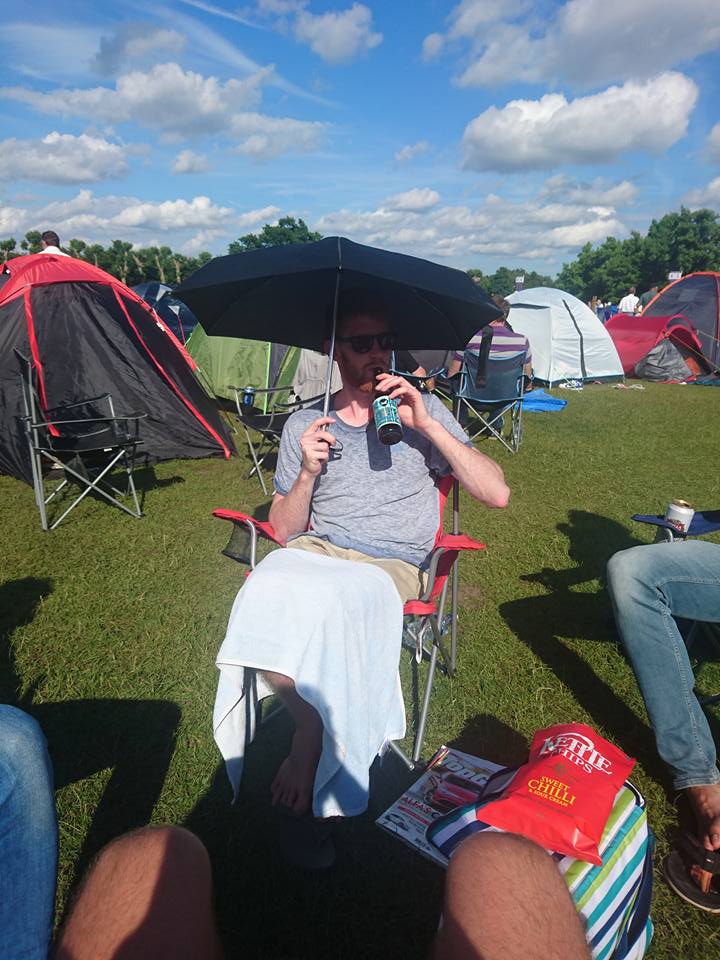
Unfolding my camp chair, I took a seat beside them and cracked a beer. It may have only been 9:30am, but the sun was beginning to peek out from behind the clouds and, as Martin, Pinot’s partner in crime, so poignantly put it: “We’re on our holiday – where there’s no etiquette for drinking.”

[QUEUE TIP #2 – The Official Guide to Queueing states that you are only allowed to bring in two beers, or one bottle of wine, per person. This is a lie. If one reversed an 18-wheeler haulage truck into the grounds and started rolling kegs off the back, nobody would bat an eyelid. Stock up for the weekend]

We spent the morning talking complete nonsense, until a guy setting up his tent opposite got out a mallet and started hammering the ground like he were Thor from The Avengers. Unable to hear one another over the racket, the Dutch guys decided to head into Wimbledon Village for lunch whilst Will, the real name for the man who looked like Henman’s double, Doug, and myself, crowded around the radio to hear the remarkable news that Djokovic had been knocked out by Sam Querrey. Cheers erupted from all four corners of the park.

[QUEUE TIP #3 – If you’re a Novak fan, keep it to yourself]

Mid-afternoon, the Honorary Stewards wound their way down the lines of tents, which had grown to about 5 rows of 100, to replace the Saturday cards we held with queue cards for the Monday. We were given #290 and #291, comfortably falling within the first 500 needed to get the option for Centre Court. The line opposite had been getting nervous however, it being unclear as to where the final ticket would actually be falling. An Italian couple about five tents down from us on this opposing row dropped to their knees in delight when they were handed their equivalent of Willy Wonka’s Golden Ticket.

“#490,” the man screamed at the top of his lungs. “YES!” I ran across and gave him a hug as Martin started chanting.

“Are you excited for the Italy game tonight?” I asked him, his national team scheduled to play against Germany in the quarter finals of Euro 2016 that evening.

“What game?” he replied, looking slightly confused.

“The football game,” I laughed.

“Alas, Federer is the only one for me,” he responded, emotionally.

I turned to look at his girlfriend, a sense of disappointment spreading across her face, and wondered how much longer it would be until she would be requesting: ‘new balls please’.

[QUEUE TIP #4 – To be in the first 500 persons, and get tickets for Centre Court, arrive by 12pm at the latest, two days before]

Once the Dutch guys had returned from a three hour lunch, we spent the rest of the afternoon playing card games and drinking further beers. Getting peckish, we decided to get some dinner. Phoning the local takeaway, we placed an order, told them our location, and simply waited. You read that right. At Wimbledon, you can get fast food delivered to the campsite. Unbelievable.

[QUEUE TIP #5 – You can get takeaway food delivered to your tent]

Just in time for dessert, as we polished off our pizzas a kid came round selling cupcakes; the expression on her face one of: ‘my parents have forced me to do this in order to complete the requirements for a Girl Guide Badge’.

“Would anyone like to buy a gluten free treat?” the fourteen year-old asked, meekly.

“Do they come with weed in them?” I joked.

“Oh sorry, are you celiac?” she responded, concerned. “Because they do have wheat in them unfortunately.”

As Pinot burst into hysterics, tears rushing down his face, she looked at us with a blank waxwork-like demeanour.

Eventually composing ourselves, we only managed to squeeze in one further game of cards before yet another kid came round; this time a little boy selling chocolate bars to help raise funds for a school trip.

“Are you off to build mud huts in Kenya, or something like that?” I queried, handing over some coins and gesturing for him to keep the change.

“No, we’re going skiing in Courchevel.”

Great, I’d just given a rich kid further funding towards having a jolly in the Alps. We polished off the beers, and as people started tucking in for the night on their luxurious inflatable beds, I curled up in my sleeping bag next to Doug, tossing and turning on the cold, hard, ground; my sunburn flaming up.

[QUEUE TIP #6 – Regardless of the weather forecast, bring sun cream and an umbrella. This is the UK we’re talking about after all]

I awoke extremely early the next morning with a dead shoulder blade, bruised hip, and wet jumper. As I unzipped the awning to reveal another baking July sun, I noticed Martin was already up, and shuffling around outside.

“How was the pub?” I asked. Shortly after we’d been conned into buying chocolate off the kid, Martin and Pinot had headed to the Auld Fields for dinner and to watch the game. This pub is only a five minute walk from the campsite and its food is absolutely ace.

“Great,” he beamed. “We met a gorgeous Swiss girl who is staying in tent 102 with her father.” By this point, everyone outside our little group had started being referred to as their ticket number.

“What was you opening line?”

“Can I use the charge socket by your chair?”

“And did it work?”

“Well I’ve now got full battery on my phone if that’s what you mean,” he giggled, before picking up a towel and wandering off to the nearby Boat Club, where there were showers available for £5 between the hours of 5am-8am.

[QUEUE TIP #9 – It is heavily warned that, if you leave your tent for more than 45 minutes at a time, the Honorary Stewards will remove it and your ticket will be confiscated. In reality however, they are also there to have a good time, and unless you take the piss by going to stay in a hotel for the night, they won’t really care. Loads of people went out for the whole afternoon, and some even went night-clubbing on the Saturday. None got kicked out]

I followed Martin twenty minutes later into the dilapidated building at the perimeter of the park, hanging up my clothes in a locker room which seemed to have maintained the same décor and amenities since The Championships began in 1877. He was still there in the communal showers when I arrived, and only after I’d washed, got changed, returned to my tent, and had breakfast, did he then eventually appear back.

“Where the hell have you been?” I asked, genuinely puzzled as to what took him so long.

“Getting my money’s worth,” he winked. “Plus, there are some areas of your body that are just simply inappropriate to wash when others are present.”

“Lovely.”

[QUEUE TIP #10 – Pay the £5 for the communal shower. You don’t want to be that person on Centre Court sweating out three-day-old body odour, especially when most others around you are dressed like they’ve just stepped off a private yacht]

The rest of our Sunday followed similar suit to its predecessor; by which I mean we sat around in the sun, drank more beer, and talked more gibberish. In the words of Ron Livingston from the classic comedy Office Space: I did nothing. I did absolutely nothing, and it was everything that I thought it could be.” Will was camping on his own, having made friends in the queue in previous years, and we were already planning our visit to The 2017 Championships. I was initially skeptical about spending 48 hours stuck in a queue in a field, however at that moment I would happily have spent 72 hours, and we hadn’t even reached the reason for us all being there yet.

[QUEUE TIP #9 – Make sure you go to the bathroom before entering the main queue on the day of play. There are minimal opportunities to go again until you're actually in the grounds. Don’t bother bringing toilet roll, as the latrines are kept well-stocked, however I’d advise you pack some hand sanitiser]

On the day you wish to enter the grounds, you are woken up at 5am by the Honorary Stewards. Campers are given an hour to get their shit together, deflate there inflatables, put their tents into luggage storage, and line-up back in numerical ticket order. Then begins the long, meandering, journey out the park and along the edge of Wimbledon Golf Course; passing entertainment-lit stands; welcome signs; and overly-buoyant employees, until your ticket is exchanged for a wristband at the security gate: The golden lettering of ‘Centre Court’ glistened off the solid blue background as I fastened it on tightly. It was 7am at this point, and we had to wait until 8:45am until the metal detectors were turned on. After what felt like only minutes however, we were sneaking in our cans of Pimm’s which had been purchased from the local supermarket; not willing to pay the £8.30 per glass they were charging inside.

At the turnstiles, we lined up at those offering tickets for Centre Court whilst hordes of fans looked on in jealousy. Handing over £104 each, we then entered the hallowed grounds and immediately looked up at the giant yellow board which showed the order of play for Monday 4th July 2016. First up on Centre Court was Roger Federer; followed by Serena Williams; followed by our compatriot, Andy Murray. What a time to be alive.

10 Countries That Don't Exist

Glasgow, Scotland, UK • June 2016 • Length of Read: 7 Minutes

A lot of people dream of visiting every country in the world. Phrases such as ‘50+ countries and counting…’ or, ‘On a mission to cross off the world’, appear on globetrotters’ blogs and social media accounts like they are badges of honour; albeit badges of honour that nobody else really gives a shit about, like the Cub Scout badge for ‘nut culture’ (Look it up, it’s actually a thing).

I’m personally not too bothered about ticking off every country on Earth. I’ll never stop adventuring to its four corners and seeking out new adventures and experiences, but there are some places I’m just not that fussed about visiting. Have you ever been to Andorra? Probably not. Well I have. And let me tell you. The most interesting thing I found to do there was order vodka jelly shots from a moderately attractive Irish blonde whilst a Japanese-fronted cover band played early noughties pop-punk tracks. If I recall correctly there were also some mountains. Tour over.

For those of you that do still dream of setting foot on all 193 United Nations member states however, let me up the ante. Like a bonus level on a video-game, I’m going to add ten more ‘countries’ to that list. Ten countries that aren’t, correctly speaking, actually countries.

They are instead referred to as Micro-Nations; pieces of land that claim to be independent or sovereign nations, but are not recognized by world governments. In order to be defined as a country you need to have and meet the following three criteria: a permanent population; a clearly defined territory; and a government capable of interacting with other states. The following ten Micro-Nations all stake independence as a result of these criteria, however have not yet gained United Nations recognition. The following ten Micro-Nations are therefore countries which don’t exist:

1) The Principality of Sealand

Probably the most famous Micro-Nation, Sealand is a wartime fortress situated 12km off the East coast of England that has claimed ‘country’ status since 1975. Built during World War II as a defense post, it was never demolished upon being decommissioned. It therefore stood unused until 1967 when one Roy Bates took over the platform as a base for his pirate radio station. After a few drinks with a lawyer friend of his, he then had the genius idea of establishing the fort as a nation state, despite it only covering a total area equivalent to two tennis courts. Now run by Roy’s son, Prince Michael, Sealand has a population of 27; publishes its own passports; prints its own stamps; and has even minted its own coins.

2) Freetown Christiania

Right in the heart of Copenhagen sits a former military barracks that lets off a heavy whiff of marijuana. Taken over by hippie-squatters in 1971 as an anti-governmental social experiment, Christiania became a self-governing collective operating under its own rules and principles. Following a dark era involving hard drugs and murder this Micro-Nation has now cleaned-up, and its 850 residents are currently deliberating an offer from the Danish government to outright purchase the 34 hectares of land they live on. I’ve personally visited the area and it’s a must-see attraction if you ever visit the Danish Capital.

3) Mayotte

Far out into the Indian Ocean lies Comoros, an archipelago of four islands which became fully independent from France in 1975… well, almost. Three of these islands voted overwhelmingly to form an independent African state, but the fourth, Mayotte, wished to remain under French rule. When The United Nations granted Comoros new country membership however, it did so for the whole archipelago so as to avoid any decolonization chaos. Mayotte therefore sits in the middle of a stalemate, being a French ruled member of the European Union on one side, and a geographically recognised part of Comoros on the other.

4) The Principality of Seborga

Hidden on the Italian border with Monaco and France is a ‘legal twilight zone’ known as Seborga. Originally a principality of the 10th Century Holy Roman Empire, Seborga was thought to have been sold to the House of Savoy in 1729; however no documentation or evidence of this was ever registered. This meant that when the Italian peninsula was unified into the Kingdom of Italy in the 19th Century, Seborga was never mentioned. The local florist now goes by the title of His Serene Highness and presides over the mountain village (population: 300) with a court of white-robed knights.

5) The Sovereign State of Forvik

When a solitary sailor crashed his vessel in the Shetland Islands during a failed attempt to circumnavigate the British Isles, he decided to just settle there. Dubbed ‘Captain Calamity’ by the Media, Stuart Hill became the sole resident of a tiny island that he named Forvik, and claimed its independence under the basis that the 0.01km2 still remained part of the old Norse Empire. The Micro-Nation’s official website states that Forvik now ‘wishes to enter into negotiations with companies with the ability to carry out oil exploration work in its waters’, however warns that ‘only those with a proven track record need apply’.

 6) Rapa Nui

The most remote place on planet Earth, Easter Island is known the world over for the giant Moai sculptures which litter its sparse landscape. Situated 3,800km off the west coast of South America, possession of this island was taken from the Rapa Nui people by the Chilean government in 1888. These Polynesian inhabitants are the subjects of the book Collapse: How Societies Choose to Fail or Survive by Jared Diamond. The author illustrates how over-cultivation of the island’s environment, in a desire to build some 887 Moai headed statues, has led to this annexed territory being permanently drained of its resources to the point that the indigenous people now struggle to survive on the island at the end of the world. Despite this however, Rapa Nui activists still fight for their right of self-determination and ownership of the island, which has resulted in violent protests with the Chilean police.

7) Principality of Hutt River

500km north of Perth, in the Western Australian outback, is Hutt River, an enclave which was claimed independent by Leonard Casley in 1970 following a dispute with the Australian government over grain quotas. Hutt River then declared war on Australia after the national tax office failed to stop demanding the payment of taxes. In response, Prince Leonard and his wife were deemed to be non-residents of the country, and the postal service refused to handle any mail sent from, or addressed to, this Micro-Nation. As a result, any incoming or outgoing post now has to be re-directed through Canada.

8) Pontinha

This will sound crazy, but Pontinha is effectively a Knights’ Templar fort that was hacked from a rock situated 700km off the west coast of Africa in the 1400s. The Micro-Nation’s case for independence is currently being analyzed by the United Nations, with Prince Barros, one of the fort’s four ‘residents’ and a schoolmaster by day, confident that Pontinha will be the Brazilian government’s door of entry to Europe when it is eventually recognised.

 9) Republic of Minerva

When the Lithuanian real estate millionaire Michael Oliver came up with the idea of forming a libertarian society, a pair of atolls in the Pacific Ocean to the south of Fiji and Tonga were identified as potential ground on which such a nation could be built. The submerging reefs were artificially constructed using concrete and coral blocks, with the more southern island being shaped into an infinity symbol. This displeased the Tongan government however, who had been using Minerva as fishing area before it declared independence in 1972. They sent out a ship to reclaim the atoll as their own, mounting a flag on the north island and declaring it part of Tonga just months after. The now-submerged Minerva is said to have some of the clearest waters and best diving in the world.

 10) The Kingdom of Lovely

As part of the BBC TV series ‘How to Start Your Own Country’, humourist Danny Wallace (of Yes Man fame) ended up turning his London flat into a Micro-Nation called Lovely. Taking the advice of eccentric leaders, including Prince Michael of Sealand, King Danny first tried to invade an island and purchase a castle before setting up an online community of residents that grew to 60,000 people. Not content on creating a currency (the I.O.U); a motto (Have A Nice Day); and a national flag (pixelated Union Jack), Danny went as far as entering his self-penned song, Stop the Muggin’, Start the Huggin’, into the Eurovision song contest in an attempt to gain legitimacy. Unfortunately the organizers didn’t quite like his sound, despite the enthusiasm.

So there you go; 10 Micro-Nations that claim statehood but don't quite exist. Who knows what will happen in the future however, with borders constantly shifting. After all, they are just imaginary concepts;  lines drawn in the sand with a stick. The real question is: Which one of the above will you attempt to visit first?

7 Reasons Why Times Square Sucks (Bucket List #139)

New York, New York, USA • May 2016 • Length of Read: 6 Minutes

At the heart of Manhattan Island lies Times Square; colloquially named the Crossroads of the World. Having its name changed from Longacre Square when the New York Times newspaper moved its headquarters to this location in 1904, Times Square acts as the hub of the Broadway theatre district; is the location for the country’s iconic New Year’s Eve countdown; and is one of the busiest pedestrian thoroughfares in the world.

For these reasons, and more, it was therefore highlighted as one of my 'must-do' things during a recent trip to New York. I’d had reservations as to whether it would actually be as mesmerising as I’d been told (I mean, it’s just a square right?), however I never quite imagined how much of a let-down the entire area would be. Here are my 7 reasons as to why I think Times Square is a little bit shit:

1) It’s Not Even a Square

If you’re going to name something, then at least have it make sense. Not only is Times Square not even a square, it doesn’t really resemble any geometric shape at all. Among other absurd suggestions, its general area has been described as a rough-polygon; two inverted triangles; a sand-timer; and, a bow-tie shape. OK, perhaps I should have done a little more research prior to my visit, but I was busy. This leads nicely on to my second reason...

2) The Selfie-Stick Wielding Tourists

Ever wondered what it’s like to be crushed in a mosh pit at a death metal concert but don’t like the music enough to buy a ticket? You’re in luck. Times Polygon is the perfect place to experience the displeasure of strangers’ sweaty bodies rubbing aggressively against you without the accompanying screaming angst. It being pointless to try and swerve around the stereotype, Chinese tourists, with their 6 ft long selfie sticks and 15-person group photos, were largely to blame for the congestion during my unfortunate visit. Dark lyrics aside however, noise pollution is still prevalent, and that’s primarily due to...

3) The Construction

Never have I set foot on an island with as much construction taking place as Manhattan. There are more than 100,000 people employed as labourers in NYC, and I don’t think a single one of them had called in sick or taken a holiday during the week of my visit. The pneumatic drill seemed to be the weapon of choice for these hard-hat wearing, slang talking, workers; closely followed by the wonky-wheelbarrow. Nobody could debate their hard work, but with Times Polygon seemingly going through more repairs that a recently bombed middle-Eastern state, they didn’t exactly have time to dilly-dally; Na’ mean? At least most of this construction could just be covered up by all of…

4) The Billboards

This is a health warning: If you suffer from latent epilepsy then please keep your distance from Times Polygon. The annual electricity bill for this small block of streets must be higher than that of Belgium. Hundreds of electronic billboards cover every square inch of the leering skyscrapers that border it, advertising the latest movies; beauty products; fashion trends; [insert consumer product here]. I’d imagine you’d be hard pressed to find a room overlooking Times Polygon that actually has a functioning window. If you are a cautious driver then I’d also heed maximum caution when navigating around these streets. As well as the large number of roadworks; blacked-out Chevrolet Escalades; and suicidal businessmen, there are also a large number of…

5) Street Performers

OK, I’ll admit that the Naked Cowboy is pretty cool. Almost all of the other street performers who brace Times Polygon however are, at best, mildly irritating. Take the fat man dressed as a giant baby who does nothing but wail for hours on end, for example. Or, how about the entire cast of frozen who, because they are wearing the costumes of loved Disney characters, feel that this gives them the right to be your best friend. At least they don’t invade your personal space as much as…

6) The Leafleting and Flyering

If I'd collected and bound every single leaflet and flyer that was shoved in my face, I swear the resulting book would have been thicker than Harry Potter and the Order of The Phoenix. Hello? I'm in New-fucking-York, there's already quite a few things going on. Even if I'd been visiting York, United Kingdom, however, I doubt I'd ever get to such a loose end that a three hour one-man re-enactment of the 'life and times of so-and-so' would sound like a good way to pass the evening. If you did find yourself being involuntarily dragged to such a performance however, one way of getting out of it would to eat some of...

 7) The Food

I'm now going to address a second cultural stereotype in this short post; that being the one about Americans having shit diets and eating too much. The food choice available in-and-around Times Polygon is comparable to that of a state penitentiary, with the hygiene standards being on a par with those found a zoo. There is also an obsession with rushing diners through their three courses as quickly as possible. One evening I ate at the Bubba Gump Shrimp Company and before my brother had even finished his starter they threw his main course on our table like it were a smelly turd. It also tasted a bit like a smelly turd. Not that I'd know what a smelly turd tastes like...

This goes to show that not all things on my bucket list will turn out to be'call home and ring your friends to tell them how good of an experience you had' awesome. And I never expected it to be. The bucket list is more an expression of: 'Hey, these are the really cool things that I’d like to experience and undertake at some point in my life, and regardless of whether they turn out to be enjoyable or not I'll still be happy to have done them'.

Thankfully the rest of my visit to New York turned out to be a roaring success.